Ayşe Özge Ağça, Grantee of the Dissemination Conference in Grant Period 3
Bio:
I am a post-doctoral fellow at ITI/LARSyS, Técnico, Universidade de Lisboa, where I research women’s healthcare and develop tangible tools supported by inclusive technologies. My interdisciplinary work draws on research-through-design and explores how embodied and participatory practices can support engagement with sensitive health data, self-knowledge, and care.
Grant supported actions and initiatives:
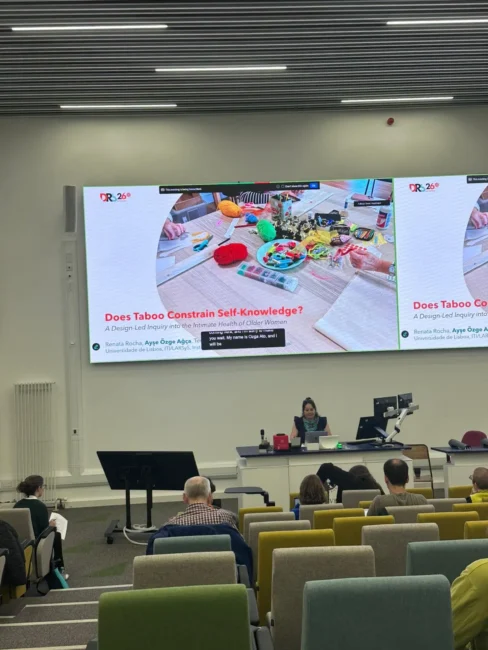
At DRS2026 in Edinburgh (8-12 June 2026), I presented our co-authored paper “Does taboo constrain self-knowledge?: A design-led inquiry into the intimate health of older women.” Written with Renata Rocha and Teresa Almeida, the paper reports on three participatory design workshops with ten women aged 65 and over in Portugal. Through body mapping, lifelines, craft materials, and collective reflection, we explore how taboos surrounding intimate health influence self-knowledge among adults aged 65 and older, with a focus on women n. Our findings show how creative and visual methods can make difficult experiences easier to express and create safe conditions for dialogue and lifelong learning around intimate health.
I also served as the corresponding chair for track 7.1, Designing Preventive Health Technologies and Practices, on behalf of Teresa Almeida, Armağan Karahanoğlu, and Anna Vallgårda, where I met with new people to discuss our current work and future possibilities.
Testimonial:
The Design Research Society (DRS) organizes large, well-attended conferences and gives contributors visibility within a broad international community. DRS2026 gave me an important opportunity to share this work with an international design research community and to discuss how designers can approach taboo and intimate health topics by co-designing with older women. Conversations about the paper helped me reflect more deeply on the ethical and methodological responsibilities of designing with older women, particularly the importance of trust, participant-led disclosure, and accessible ways to make embodied knowledge visible. The conference also connected me with researchers working across participatory design, health, and care, opening valuable possibilities for future exchange and collaboration. These discussions strengthened the next steps of my research: developing inclusive tools that support more compassionate conversations about intimate health and that recognize later life as a stage of agency and ongoing learning. I am very grateful to PAAR-net for supporting my participation as a paper presenter and track chair. Even after the conference, we received messages and requests to connect from researchers at several universities, an encouraging sign that the paper had opened conversations beyond the conference itself.