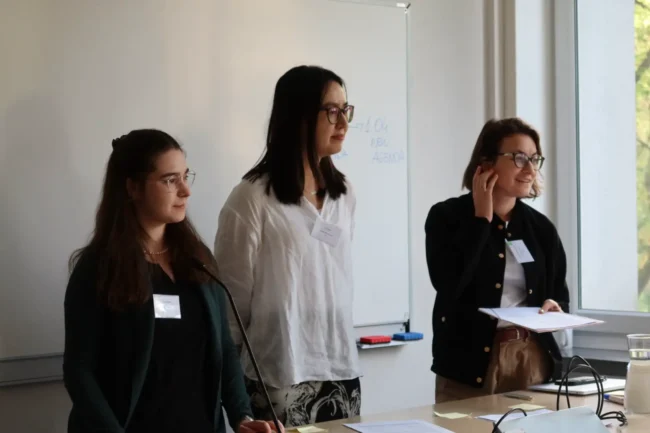
Bio:
I am a student researcher in Educational Sciences at Goethe University Frankfurt (Germany) and worked on intergenerational care relationships within the international research project InterCare: “Intergenerational Care Relations: Challenges and Potentials for Reconciliation of Education and Care in Ageing Knowledge Societies.” My research interests include civil society and interdisciplinary ageing research. I am particularly interested in life course transitions, including transitions into caregiving relationships, constellations of inclusion and exclusion and issues on social participation and social cohesion at different stages of life.
Grant supported actions and initiatives:
The Virtual Mobility provided an opportunity to collaborate with researchers from Jagiellonian University in Krakow and to jointly reflect on findings and methodological approaches within the InterCare project. Throughout the mobility, we exchanged perspectives on participatory research, discussed the ongoing data collection, and worked collaboratively on a policy brief translating key research findings into implications for policy and practice. The mobility also supported the preparation for the Eurocarers conference in Krakow, where we presented the InterCare project and connected with other researchers, care organisations, practitioners, and other stakeholders from Europe and beyond. In addition, the virtual exchange created valuable opportunities for researchers with interdisciplinary backgrounds and at different career stages to learn from one another and to develop further methodological and epistemological perspectives.
Testimonial:
The Virtual Mobility gave me a valuable opportunity to exchange ideas and collaborate with researchers from interdisciplinary backgrounds and at different career stages. I particularly appreciated the space it created for discussing both the substantive findings of our research and the methodological questions that arise when working with participatory approaches. Working together on the policy brief was especially valuable, as it allowed us to think about how research findings can be communicated beyond academia and translated into implications for policy and practice. Preparing for and participating in the Eurocarers conference further broadened these exchanges and enabled me to connect with researchers, practitioners, organisations, and people with lived experience of care.
Beyond the concrete outputs, the Virtual Mobility was an important opportunity for my own development as a researcher. The cooperative work helped me to deepen my understanding of participatory research and to reflect on possible future research and collaboration opportunities. I am very grateful for the support provided through the COST Action, which made this international and interdisciplinary exchange possible and helped establish connections that I hope to continue in the future.